Resume tailoring guide
How to tailor a resume to a job description
A tailored resume makes the connection between your real experience and one employer's needs easier to understand. Here is a repeatable way to do it without keyword stuffing or invented claims.
To tailor a resume to a job description, first identify the employer's priorities, then match each priority to evidence you genuinely have. Reorder and rewrite the resume so the most relevant achievements are easy to find, use the employer's terminology where it accurately applies, and complete a final accuracy and formatting review.
In this guide
What does tailoring a resume mean?
Resume tailoring means adapting a core resume for a particular vacancy. The underlying facts do not change. What changes is the selection, order, emphasis, and wording of the experience most relevant to that role.
A hiring team should be able to answer three questions quickly:
- Does this person appear to meet the important requirements?
- Where is the evidence that they have done comparable work?
- What results or impact did they produce?
This is why a generic resume often underperforms even when the candidate is qualified: the reviewer has to do too much work to connect the experience to the vacancy.
1. Read the job description for priorities
Read the job description once for context, then a second time to identify patterns. Separate the information into:
- Core outcomes: what the person will be expected to deliver.
- Essential capabilities: skills, experience, licences, or qualifications the role clearly requires.
- Tools and domain language: systems, methods, regulations, products, and terminology used in the work.
- Behavioural expectations: leadership, stakeholder management, problem-solving, communication, or autonomy.
Repeated requirements and items near the beginning of a list often deserve close attention, but do not assume every bullet has equal importance. The role's stated purpose and main responsibilities usually provide better context.
2. Map each important requirement to real evidence
Create a simple evidence map before editing. For each important requirement, record the strongest example you can support from your work, education, volunteering, or projects.
| Role requirement | Evidence to look for |
|---|---|
| Lead cross-functional projects | A project you coordinated, who was involved, the constraint, and the result. |
| Improve operational performance | A measurable reduction in time, cost, errors, risk, or rework. |
| Manage senior stakeholders | A decision, conflict, change, or complex message you helped navigate. |
| Use a named platform | Where, how often, and for what outcome you used that platform. |
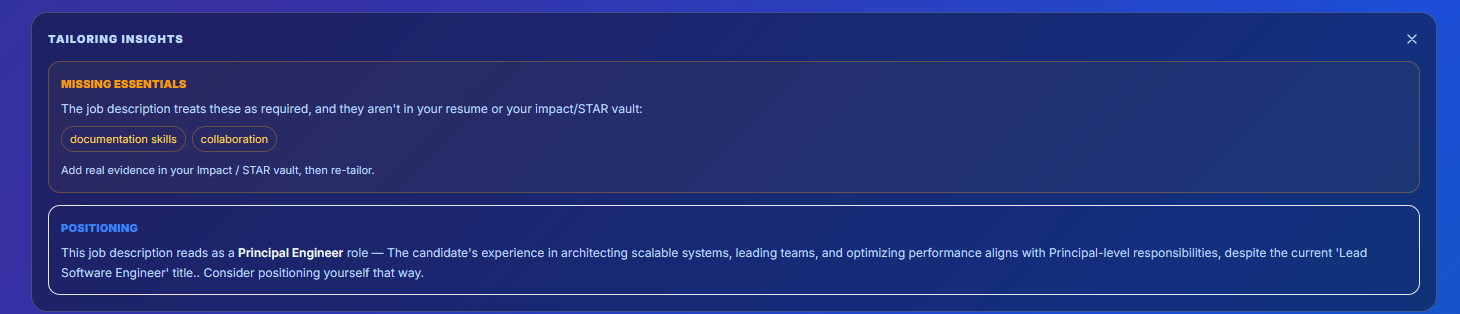
If you cannot find genuine evidence for an essential requirement, leave it as a gap. Do not ask AI to fill it. You may still decide to apply, but the resume should not imply experience you do not have.
3. Restructure before you rewrite
Good tailoring is partly editorial. Move the most relevant information into the areas a reviewer is most likely to scan first:
- Update the professional summary so it reflects the target role and strongest relevant value.
- Bring role-relevant skills forward and move weakly related items down.
- Within each job, order achievements by relevance rather than chronology.
- Give more space to positions and projects that best demonstrate the target capabilities.
- Remove low-value detail that competes with stronger evidence.
You may not need to rewrite everything. Often the largest improvement comes from choosing better evidence and changing its position.
4. Rewrite bullets around action, context, and result
Weak resume bullets describe activity without showing contribution. Stronger bullets make the work and its effect concrete.
Before: Responsible for monthly reporting and stakeholder meetings.
After: Consolidated monthly performance reporting for six operational teams, giving senior stakeholders one view of delivery risks and reducing preparation time by 30%.
This fictional example works because it adds scope, audience, purpose, and a result. The exact number should only be used when the candidate can support it. Where no reliable metric exists, use other specifics: scale, complexity, frequency, risk, reach, or the decision enabled.
5. Use job-description keywords honestly
Relevant terminology helps both software and people understand the match. Use the wording from the job description when:
- it is the normal name for a skill, method, system, qualification, or responsibility you actually have;
- your existing resume uses an obscure synonym that may hide an obvious match; or
- the phrase adds precision rather than empty repetition.
Do not paste a hidden keyword block into the document, repeat phrases unnaturally, or claim every preferred skill. A useful reference is Indeed's current explanation of how to tailor a resume to an employer's job description, which similarly emphasises relevant qualifications and measurable results.
6. Complete an accuracy, readability, and ATS review
Before submission, check the tailored version as a fresh document:
- Accuracy: Can you explain and defend every statement in an interview?
- Relevance: Are the employer's main needs answered clearly?
- Evidence: Are important claims supported by examples or results?
- Readability: Can a person scan the structure and find key information quickly?
- Consistency: Are titles, dates, punctuation, spelling, and tense consistent?
- Instructions: Is the file type and naming convention appropriate for that application?
For Australian job seekers, National Careers Week also provides a concise ATS-compliant resume information sheet.
Resume tailoring checklist before you apply
Use this final checklist after tailoring and before uploading the document. It catches the small errors that are easy to miss when you have been working on the same application for too long.
- The company and role details are correct.
- The most important requirements are easy to find.
- Your strongest relevant evidence appears near the top.
- Every claim is accurate and defensible in an interview.
- Employer terminology is used only where it truthfully applies.
- Achievements include concrete outcomes, scale, or context.
- Dates, tense, spelling, and punctuation are consistent.
- Headings and formatting are simple enough for ATS parsing.
- The correct resume and cover letter versions are attached.
- The filename, contact details, and links have a final human review.
Can AI tailor a resume for you?
AI can make comparison and drafting faster, but it needs good source material and clear boundaries. Give it the complete job description, your actual resume, and relevant achievement evidence. Ask it to identify gaps before it rewrites anything. Then review every output for accuracy, tone, and unsupported assumptions.
NextOrbit turns that process into a connected workflow: save the role, map requirements, add real career evidence, tailor the resume, review ATS-style alignment, and edit the result in the Studio.
Apply the process
Tailor your next resume in NextOrbit
Keep the job description, evidence map, tailored document, ATS-style review, and application status together.
Related guides and tools
- AI resume tailoring with NextOrbit
- AI resume tailoring for Australian job applications
- How to make a resume ATS friendly
- How to use AI without inventing resume experience
- Keep each tailored resume with the right application
- Write a matching cover letter from the same evidence
- Prepare STAR stories for the interview